Maureen Duffy at 80: In Times Like These
FIGHTING AND WRITING
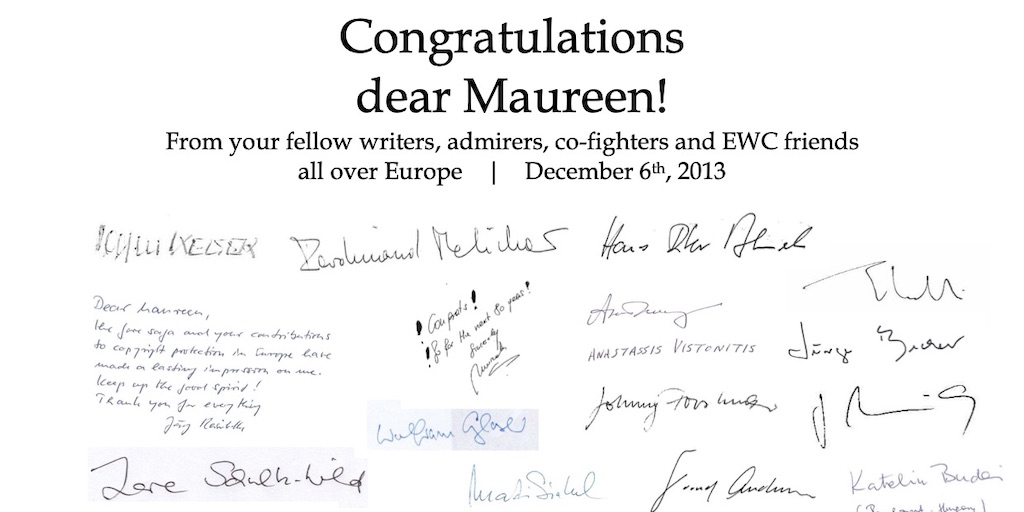
Header image: Signatures and well wishes from friends and colleagues at the European Writers' Council.
In this collection of contributions, under the heading ‘Fighting and Writing’, we hear from writers and those who have worked alongside Maureen Duffy to protect culture and authors’ rights and to create solidarity between writers all over the world.
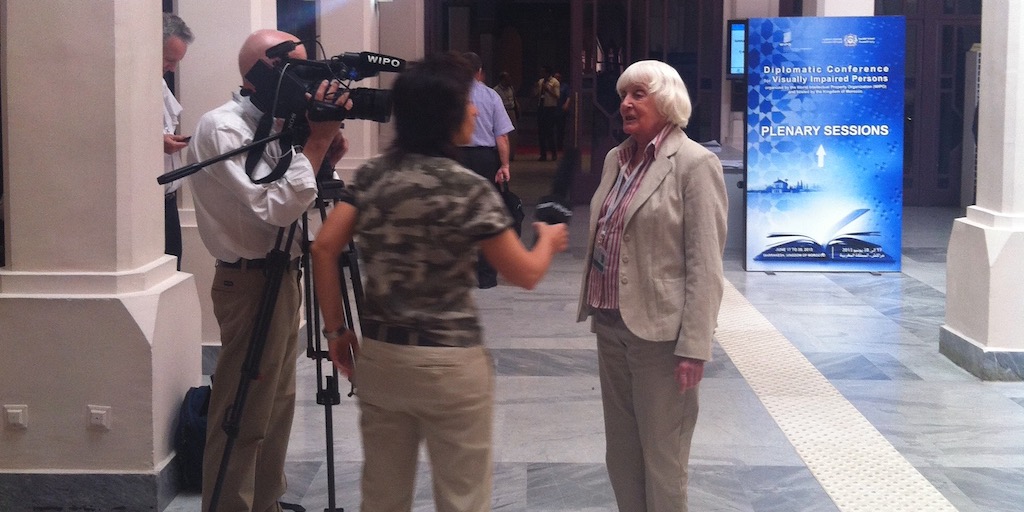
Contributions by Lore Schultz-Wild, Ingrid Protze, Sabine Herholz and Kati Budai come together to form a panoply of information about Maureen’s contribution to the European Writers’ Congress (EWC), in particular during the post-communist period after the fall of the Berlin Wall, when EWC was a vital part of reconciling what had been two vastly different worlds under Soviet rule. Writers in former soviet-run states had to contend with the rules of a free market. Maureen’s work to bring together “common efforts for common interests” was vital in helping writers to learn about, implement and defend their rights effectively in ways that would protect their work and enable them to build an environment in which writers could work independently, internationally and exercise their free speech and copyright after a period when they had been heavily compromised.
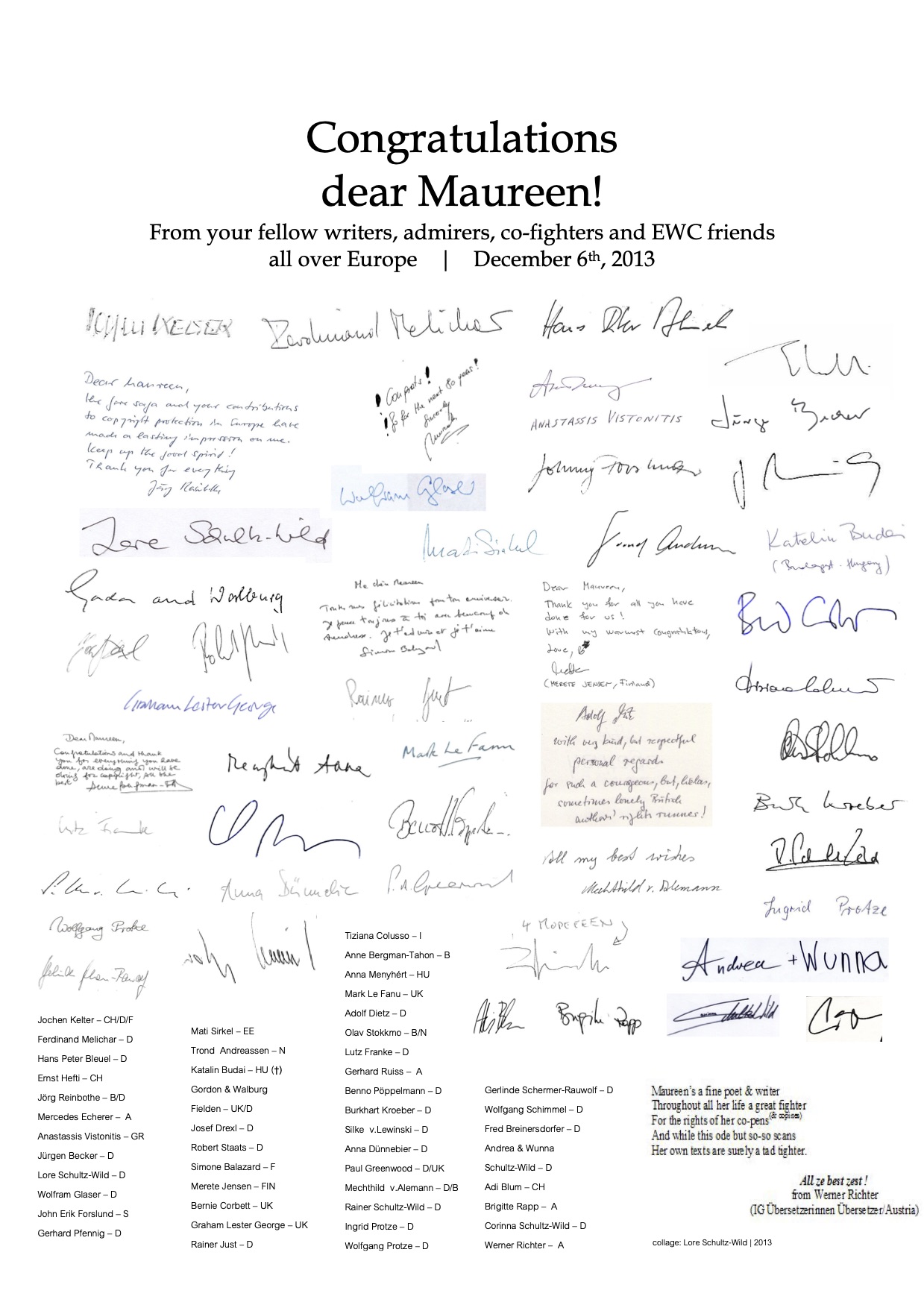
Signatures and well wishes from friends and colleagues at the European Writers' Council.
Olav Stokkmo and Katie Webb describe Maureen’s international work beyond Europe - her participation in IFRRO, the international network of Reproduction Rights Organisations, which license authors’ work and distribute the proceeds to authors, and later in building the International Authors Forum, an initiative to bring together authors all over the world to defend their rights, enable them to make a living and to exercise their free speech.
Jill Gardiner contributes a fascinating and informative read about the work that went into fighting the systemic discrimination against homosexuality in the UK in the 1960s. Gardiner describes Maureen Duffy’s full participation in this work - brave and extremely effective - writing and speaking about it as prominently as possible. She also discusses the impact of Maureen’s publication of The Microcosm (1968) - a lifeline for many women struggling with the social taboos of their sexuality at the time - and the discovery of Maureen’s own sexuality charted in her semi-autobiographical novel That’s How it Was (1962).
Katie Webb, Editor
Sections and Chapters
Browse articles on Fighting and Writing